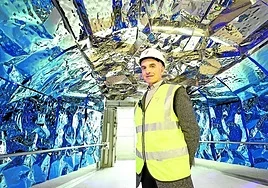
A piece of the sea under the new Topo
A piece of the sea under the new Topo
The access canyons to the stops in Donostia feature a creation by Víctor Goikoetxea inspired by “the movement of the water in the bay”
Donostia is sea. It is its three beaches, the bay of La Concha and the waves that break against the coast. But it is also a city that advances, that innovates and that seeks new ways of moving. Two realities that, at first glance, seem to have little in common, converge at the new access points for the 'Topo' (local railway) in Donostia. Here, artist Víctor Goikoetxea has brought the movement of the sea into the entrance shafts leading to the Benta Berri, Matia, Centro, and La Concha stations, through an intervention that blends art, architecture, and mobility. The work, titled 'The Echo of the Bay' ('El eco de la Bahía'), seeks to "harmonize the connection between the surface of Donostia and its new underground world, using the movement of water as a unifying thread," explains the creator—an artist also known for projects such as the Miramar pedestrian tunnel. What might initially appear to be a purely aesthetic piece actually stems from an architectural necessity. The vitrified steel panels used throughout the rest of the facilities could not be installed on the curved, irregular surfaces found in the initial access sections—the areas reached after descending the stairs. It was at this point that Euskal Trenbide Sarea (ETS) reached out to Goikoetxea to address this engineering challenge through a creative approach. The artist did not hesitate to draw inspiration from the sea, noting that "this metro system was built in a coastal area—on land reclaimed from the sea and its marshes." For this reason, he describes his work as “a tribute to the identity of San Sebastián, uniting the strength of engineering with the poetic delicacy of our waves.”
“It is a living work”
The shapes, reliefs, reflections, and colors that make up the walls of these access passages seek to convey the sensation of being “in the depths of the sea, underwater.” The intervention It also connects with the metallic structures known as "coralinas" (coral-like forms) that adorn the stations—structures conceived to "evoke minimalism and avoid visual clutter." Their name refers precisely to their resemblance to marine corals, an element that Goikoetxea also incorporates into his work. "The water on the walls supports the coral. Just like when you’re diving, the light is above. That’s why we used a mirror finish, which reflects the light. It’s a living piece of work—one that changes as people walk through it or as the sun reflects off it," he explains.
But that’s not all. Goikoetxea reveals that the elevator exits, located beneath a vaulted ceiling, will also feature their own artistic touch. "At each station, they will be covered with period writings and images, so that we don’t forget where we come from. At La Concha, we’ll see the *Belle Époque*; at Benta Berri, references to the old Lagarto soap factory or the Suchard candy factory... All of that is also part of who we are, and I wanted to represent it," he explains.
Guided tours open to the public—scheduled for next Tuesday, Wednesday, and Thursday—will offer a chance to experience these works firsthand. To participate, you must register via the website topo.eus.